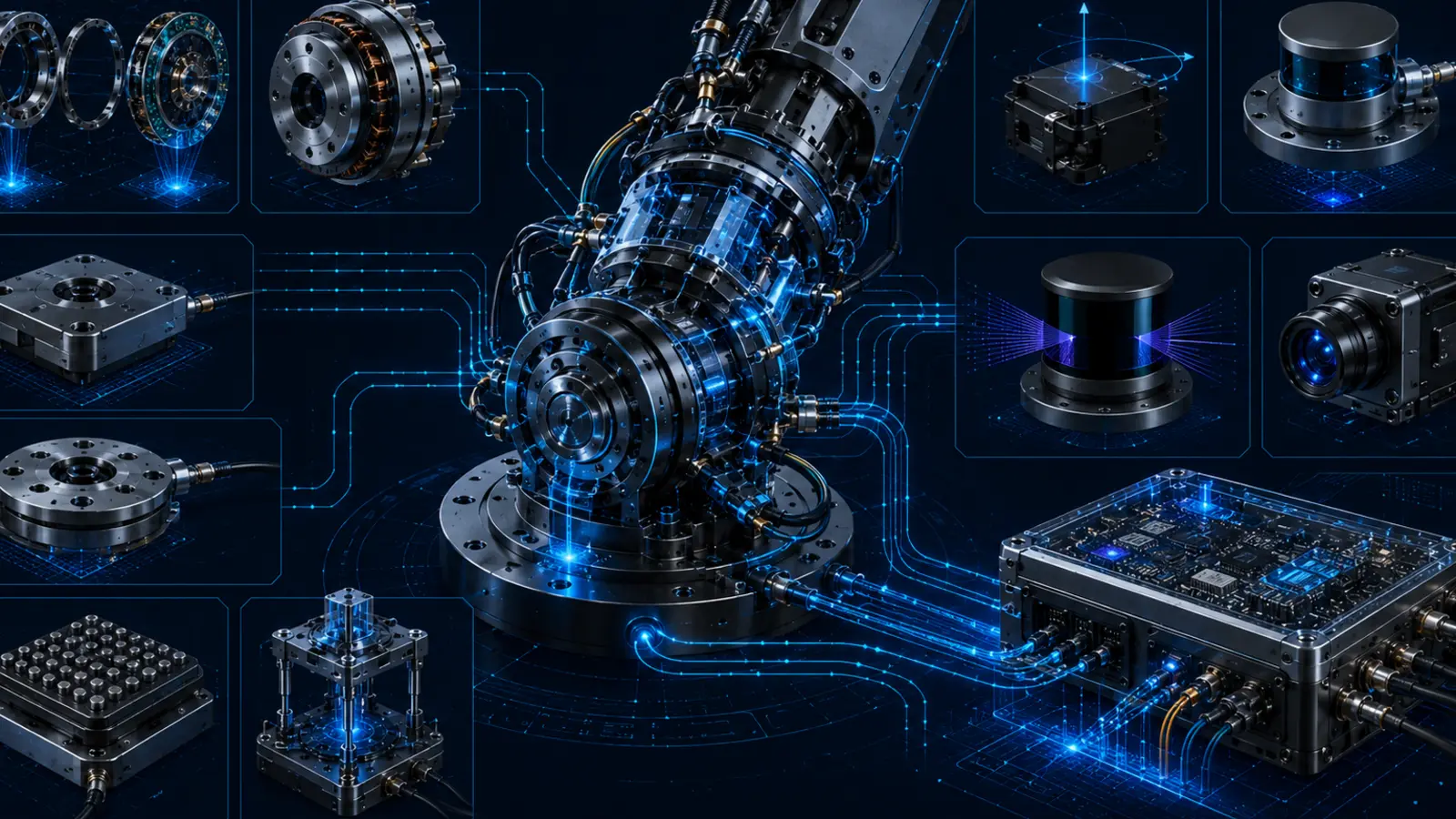
Integration of IMUs, load cells, joint torque sensing, tactile arrays and contact-state measurement.
Revision 1.9.1 · Phase 2 reviewed topic gateway
Public-safe scope: this page establishes engineering ownership, interfaces and evidence expectations. Application-specific dimensions, performance values, algorithms, design allowables and proprietary implementation details remain controlled.
Engineering Context
Purpose and Responsibility
Integration of IMUs, load cells, joint torque sensing, tactile arrays and contact-state measurement. Within Sensor Integration, Transducers & Metrology, this topic is reviewed as part of the complete physical-and-digital control loop, with assumptions and ownership made explicit at every interface.
Parent-System Role
This gateway turns physical behavior into trustworthy measurements. It controls sensor selection, mounting, conditioning, timing, calibration and fusion so downstream control and decision functions receive traceable data.
Engineering Workflow
Definition Through Verification
Define Translate the topic into bounded use cases, modes, requirements and acceptance criteria.
Analyze Model key behavior, uncertainty, loads, timing, energy and credible off-nominal conditions.
Integrate Control mechanical, electrical, optical, software, data, safety and human interfaces as applicable.
Verify Use configuration-matched analysis, inspection, simulation, demonstration or test to close requirements.
Typical Work Products
Measurement requirements and uncertainty budgets
Sensor, mounting and signal-chain architecture
Timing, synchronization and data-interface definitions
Calibration, traceability and measurement-system evidence
Topic Family
Sibling Pages in Sensor Integration, Transducers & Metrology